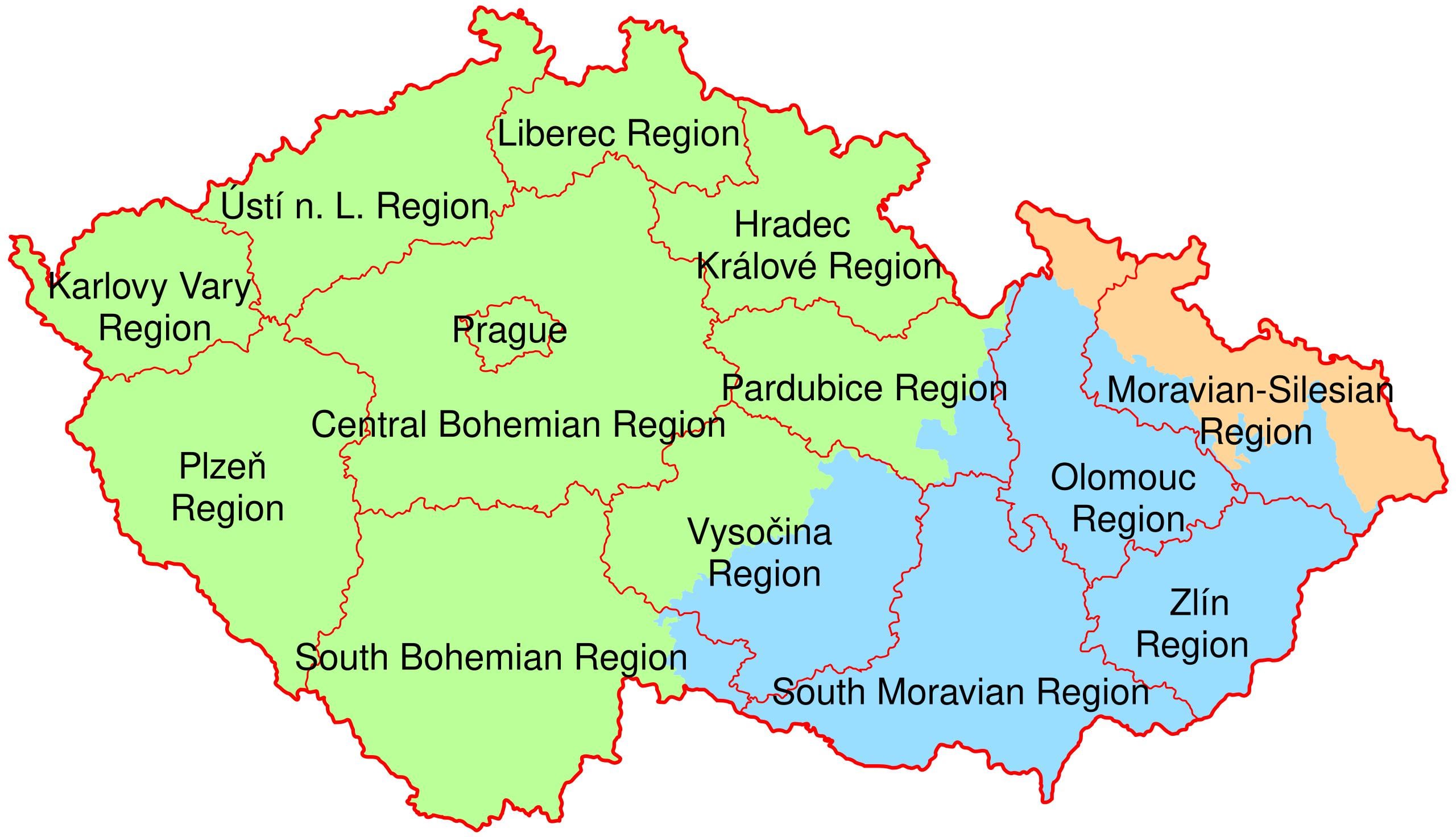
Perché gli attuali confini regionali in Cechia non si sovrappongono a quelli storici?
https://i.redd.it/f99pdqbgiuef1.jpeg
di Tasty-Chemical-8884

Perché gli attuali confini regionali in Cechia non si sovrappongono a quelli storici?
https://i.redd.it/f99pdqbgiuef1.jpeg
di Tasty-Chemical-8884
13 commenti
Because the point of administrative divisions is to have regions of roughly same size.
Because there’s no reason for them to overlap
While the Czech constitution from the beginning foresaw some division of the originally unitary state, dividing it into Bohemia and Moravia&Silesia was perceived as a dangerous idea, as some fierce Moravian nationalists were juggling the idea of secession from Czechia and were quite noisy while at it. So there was no division introduced for the first 10 years of existence of Czechia.
The regions were only introduced quite late, upon entry into the EU, as the EU required some kind of division, for administration of EU money to be poured into the least developed regions first and foremost.
The point was to have regions of approximately same size, but that was eventually a bit fucked up during the adoption of the bill in the parliament, when politicians with strong regional ties introduced changes and more regions than originally planned were created (that is why we have the Karlsbad region or both Hradec AND Pardubice regions, as the animosity between Hradec and Pardubice would not allow for a single region as originally foreseen). The donut shaped Central Bohemia is also a clusterfuck.
Additionally, especially the historical Moravian-Silesian border was rather porous, with a number of enclaves and exclaves; reintruduction of those would create a lot of problems, too.
As someone from Moravia I believe the idea was to make any Moravian separatist ideas more complicated. Maybe I am wrong though
Medieval borders belong to history. Ostrava, third largest city lies in both historic regions. Jihlava has some neighborhoods in both sites of the borders. Along the Bohemian-Moravian borders, many small municipalities are in both historic regions. Subsequently former Sudetenlands at north and south made historic population tied to either province obsolete.
Moravian/Bohemian regional governments and administration do not exist for nearly 80 years. The population distribution gravitating toward regional centres make sense in regions over antiquated historical lands.
No need for them to overlap.
Because why should they?
In some way this was one of possible moves how to erase Movement for Morava-Silesia autonomy from 1990s. It’s literally just one and only reason why nonses as a “kraj Vysočina” exist. You barely found a hilly area that is fundamentally workable metropolitan area anywhere in the world, but Vysočina was the last added exactly to purpose to cease eager for Moravian autonomy, or for bundesland system similar to neighboring Germany, effectively forever. More information just in Czech language, on wiki https://cs.wikipedia.org/wiki/Kraj_Vyso%C4%8Dina – “Dizkuze o zřízení” section. Next reasons were give a poses to many of own middle class politicians in parties like Cssd or ODS to decent life on rural.
When the communists dissolved historical lands as administrative regions, they created new regions that purposely don’t follow the old border. The reason was to weaken regional government and identity and to strengthen the central government. We’ve kinda just continued to update these new regions and never reverted to the historical ones.
In Eastern Germany the communist government did the same, but they went back to the old divisions after reunification with Western Germany.
Kraje are too small in order for perníkáři z pardubic and other cases not to be butthurt. We should have had ~ 5 kraje/země at best. Waste of money and people.
Each “big” city wanted their own region, so they got it.
Because Prague was worried about Brno, essentially. It was an attempt at centralization by decentralizing into roughly same-sized parcels to which people had no historical loyalty, unlike Moravia and Silesia, which do have certain cultural characteristics.
None of those lines are real borders. It doesn’t matter. Few decades ago there was a need for bigger administrative units than districts so they joined some together to create provinces usually centered around bigger cities.