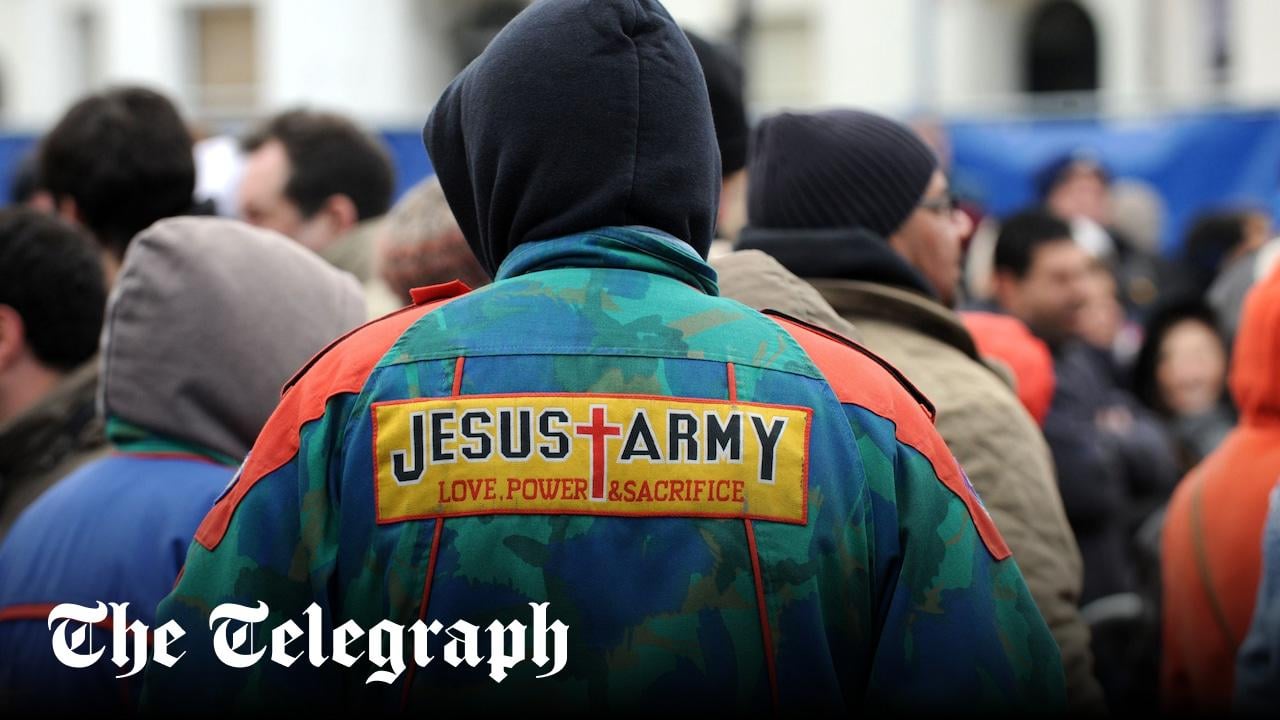
“Diamo i nostri genitali a Gesù”: il culto che ha promosso il celibato mentre copre il proprio abuso
https://www.telegraph.co.uk/tv/2025/07/27/inside-the-cult-of-the-jesus-army-bbc-two/
di BestButtons

“Diamo i nostri genitali a Gesù”: il culto che ha promosso il celibato mentre copre il proprio abuso
https://www.telegraph.co.uk/tv/2025/07/27/inside-the-cult-of-the-jesus-army-bbc-two/
di BestButtons
8 commenti
First, the link to the BBC programme: https://www.bbc.com/mediacentre/proginfo/2025/30/inside-the-cult-of-the-jesus-army
Then the article contents:
*By Etan Smallman, 27 Jul 2025 – 11:00AM BST*
Sarah left the Jesus Army 21 years ago. She has been in therapy, on and off, ever since, trying to reclaim her personality and dispense with a decade of indoctrination that saw her given the “virtue name” Sarah Submissive and taught to suppress her “Jezebel spirit”.
But it was only while preparing to appear in a new BBC documentary about the church that she finally concluded it was a cult.
In BBC Two’s Inside the Cult of the Jesus Army, Sarah, now 53, is filmed in a group therapy session in Derbyshire trying to unpack her former life. She and other ex-members are seen studying a formal checklist, including points such as “Dangerous leaders make important decisions about converts’ lives”.
It is a session on “trauma theory”, however, that most affects Sarah. She breaks down when the participants discuss “appeasing, that is pleasing others to reduce harm”. She is so distressed that she gasps for breath, says she feels she is going to be sick and flees the room.
It brought back memories of the excuses she made for the “Elder” who psychologically and sexually abused her for four years from the age of 21. “I think I just realised how I’d blamed myself really for somebody else’s behaviour,” she tells the Telegraph on a video call. “I’d told myself I’d been asking for it. It was just that realisation: they literally crushed my personality, particularly that person.”
Her tormentor – whose abuse extended to “having total control over your decision-making” – would molest her under the table while “his wife would be sitting opposite”. The man, who was never prosecuted, was supposed to be “my Shepherd, so looking out for me and not actually violating me”.
The Jesus Fellowship was established in 1969 by the firebrand Baptist preacher Noel Stanton in Northamptonshire after he was “visited by God and received the Holy Spirit”. This led him to favour a brand of Neo-Pentecostal Christianity that involved euphoric worship, having decided he was a prophet speaking God’s will and determined to “make the Earth tremble”.
By the 1980s, it had been rebranded as the Jesus Army, and was drawing in vast numbers of young people through its camouflage jacket-clad street recruiters and warehouse raves. Offering a fresh-faced version of the Salvation Army, it targeted “street kids, addicts, the poor, the homeless”. By 2001, the Army had almost 100 communal homes across the country, from London to Leicester. As late as 2014, months before the police launched an investigation, they appeared in a Grayson Perry documentary and in one of his ceramics, in the style of a medieval enamelled chest containing a holy relic.
Sarah had lost both her mother and father by the age of 15 and was seeking not only a surrogate family but a faith in an afterlife, “because I wanted my parents to be somewhere”. She was just one of thousands of converts amassed by the Army over 40 years, attracted to a dream of harmonious communal living and moral purity. Many signed the “Celibates’ Covenant” or, as Stanton put it in one of his impassioned sermons: “Surrender the middle part of you… now we give our genitals to Jesus.”
The reality was far less sacred. Children as young as two were given “roddings” by assorted adults with birch canes secreted around the Fellowship’s houses. Many teenagers were placed in households separate from their families and taught to place their trust in the all-male Elders, who laid down increasingly arbitrary rules. Everything from reading to crisps was outlawed as “worldly”. Young children were told they were possessed with “demonic spirits” and sent for exorcisms. Adherents, speaking in tongues, could be found convulsing on the floor. In the 1970s, one member died on a railway track and another was found naked in the garden in December, dead from exposure. And sexual abuse was rife.
Across two one-hour films, survivors give harrowing testimony. Abigail was 14 when she was sexually assaulted and told “if he didn’t ejaculate, it’s not rape”. Nathan was abused over eight years from the age of 10 (by a man who received an 18-month suspended sentence). Philippa was 12 when she saw her 13-year-old friend being indecently assaulted by an Elder. After the victim attempted suicide, Philippa was branded “a traitor” by Stanton and the perpetrator was sentenced to three months in prison before “he was welcomed back into the community, into a leadership position”.
Thirty-three allegations have been made against Stanton himself, including the sexual assault of children. Yet the most shocking fact is saved until a title card at the very end: “It is estimated that one in six children in the Jesus Army were sexually abused.”
Stanton’s grip on the organisation ended only with his death in 2009, aged 82, when he was replaced by the “Apostolic Five”. In the wake of Jimmy Savile and other scandals, the Army’s insurance company asked about any historic cases of abuse before agreeing to renew the policy. This prompted a wave of disclosures, which were compiled in a “massive file of papers” that, when requested, was handed over to police.
Operation Lifeboat was launched in 2014 and over two years gathered 214 allegations of physical and sexual abuse, mostly against children. Only five members were convicted. Two were jailed – the longest for three years, for anal rape. DC Mark Allbright, of Northamptonshire Police, blames a “closing of ranks” among the Army’s leadership for the dearth of prosecutions, with some worried about the effect on the church, and others “personally implicated as well”.
The Apostolic Five told the programme makers: “In 2013, we as the senior leadership initiated a wide-ranging process that invited disclosures of any kind of abuse, both historic and recent, and referred all such reports to the authorities.”
The crimes are not just documented by victims. Jez, appointed a Shepherd in Leicester, admits he was informed of “rapes” and “sexual activity with minors” in confession. When he raised it within the organisation, he was told “the power of that sin was under the blood of Jesus and therefore cancelled out”.
Director Ellena Wood, who spent three years on the films, challenges him with “the difficult question”. She posits: “There will be some people who will sit at home and say, ‘What on earth were you doing not reporting it to the police?’”
“It’s a responsibility of giving a contributor the opportunity to explain why they didn’t do something,” she tells me now. “What Jez explains in that moment is this grip that this organisation has over you, where essentially if you do something they tell you not to do, you’re going to hell or you’re going to get kicked out and your entire life is going to fall apart.”
An Elder, David, is reduced to tears as he faces up to the harm caused by the church he still loves, while clinging to the idea that just five convictions “said that it wasn’t institutionalised”.
“The thing with David,” says Wood, “is that he was really processing [it all] in that interview. I thought David was very courageous in the way that he actually goes to that space and acknowledges what happened.”
A psychologist was on hand before, during and after filming and the production team has offered advice on making social media profiles private to limit the contributors’ exposure to any social media backlash.
In 2019, the Fellowship announced it was closing and liquidating assets, including a property portfolio worth an estimated £50 million (built up from members’ own house sales and a thriving business empire including a health food shop and a building supply company). Solicitor Kathleen Hallisey represents more than 100 of the survivors, all of whom have received their compensation payments as part of the redress scheme launched in 2022.
“The biggest takeaway for me is that any government body should not be complacent in thinking that this was a strange anomaly that happened in Northampton many years ago,” she tells me. “We have high-control groups operating throughout the country and there’s been a proliferation since Covid [one expert has estimated there are 2,000]. So, this is absolutely a scenario that could happen again. None of these leaders have been criminalised because our coercive control laws only apply to domestic and intimate partner relationships.”
Sarah left after tiring of a life focused more on “gaining souls than making friends”. Her husband wanted to remain, so her marriage broke down at the same time. She is now working as a child and adolescent mental health nurse, and picking up the pieces of her life. Although she understands the need for recompense for others, she has not pursued a claim herself. “I don’t think money, for me, would make that much difference because you’ve still got to deal with whatever you’ve got to deal with, haven’t you?”
Instead, she hopes the documentary may offer her a form of closure as she still “takes time to adjust and be part of life again”. Even after more than two decades, the old Sarah is still re-emerging.
“I’ve regained a lot of my confidence,” she says. “I’ve learned that it’s OK to dress in certain ways and not think I’m going to be causing some man to stumble and lead them to hell.”
*We give our genitals to Jesus*
For a second I thought Britain was reviving the [Skoptskies](https://en.wikipedia.org/wiki/Skoptsy).
Half the teachers in Northampton seemed to part of this mob in the 80s
>We give our genitals to Jesus
Did Jesus consent to that?
An outstanding contribution to the greater community be removing themselves from the gene pool.
This is your daily reminder that statistically it’s not LGBTQIA+ people, it’s clergy.
It’s people like this who really give jesus the willies
[removed]