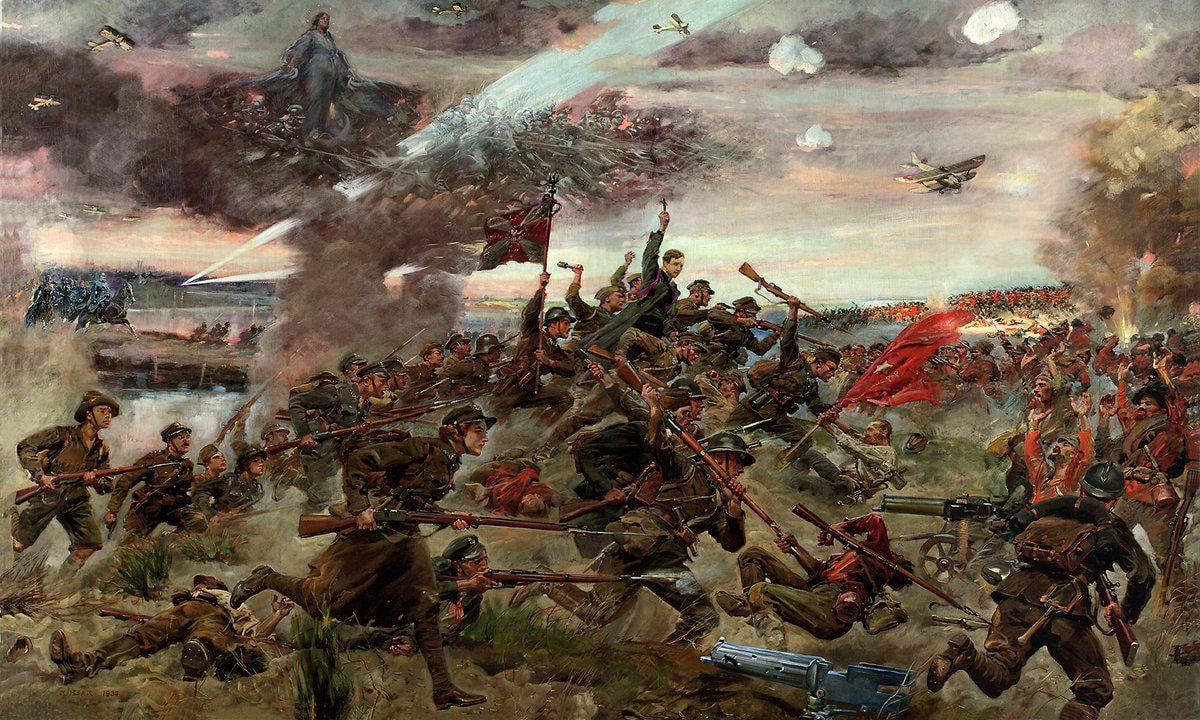
In questo giorno, il 15 agosto 1920, l’esercito polacco combatté la Battaglia di Varsavia*, respingendo le forze bolsceviste che cercarono di cogliere il controllo sull’Europa.
https://i.redd.it/2dqclckm75jf1.jpeg
di Auspectress

In questo giorno, il 15 agosto 1920, l’esercito polacco combatté la Battaglia di Varsavia*, respingendo le forze bolsceviste che cercarono di cogliere il controllo sull’Europa.
https://i.redd.it/2dqclckm75jf1.jpeg
di Auspectress
2 commenti
The Battle of Warsaw was one of the most important moments of the Polish-Bolshevik war, one of the most decisive event in the history of Poland, Europe and the entire world. However, excluding Poland, this fact is almost completely unknown to the citizens of European countries.
It was noticed already in 1931 by a British diplomat, Lord Edgar Vincent d’Abernon, a direct witness of the events who, in his book “The eighteenth decisive battle in the history of the world”, wrote: “The contemporary history of civilisation knows little events of more importance than the Battle of Warsaw in the year 1920. It also knows no other which was more overlooked.”
To better understand the origin and importance of the battle of Warsaw, one needs to first present a short summary of the Polish-Bolshevik war and, first and foremost, to describe the goals of both fighting sides. First, we need to state the obvious that the Bolshevik regime, led by Vladimir Lenin, was set for expansion from the beginning. As a prolific American historian, prof. Richard Pipes stated: “the Bolsheviks took power not to change Russia, but to use it as a trampoline for world revolution”.
The road to Europe opened up when Germany lost the First World War and signed the surrender on November 11^(th) 1918. The German troops then systematically retreated from the occupied lands of Ukraine, Belarus and other Baltic states. They were immediately followed by the Bolshevik Red Army, fulfilling Lenin’s orders to begin its “freeing” march west. This operation had a telling codename – “Vistula”. The most important job of the Bolsheviks was to break through to Germany and Austria which were filled with revolutionary atmosphere. To do that, they needed to get rid of the “barrier”, meaning, as Joseph Stalin wrote, “the dwarf national states which wound up between the two huge sources of revolution in the East and West”.
>
One such barrier was, first and foremost, Poland which just regained independence following the defeat of Germany and the fall of the Austrian-Hungarian empire. On November 17^(th) 1918, at the Red Army briefing, its commander Leon Trotsky predicted the sovietisation of Poland and Ukraine as “the links binding Soviet Russia with future Soviet Germany” and the first stage in building “the Union of European Proletariat Republics”. Poles lived mainly at the territories of modern Belarus and Lithuania, which were invaded by the Bolsheviks. A Polish Self-defence was created there, counting 10 thousand men, which was part of the Polish Army and its commander, Gen. Władysław Wejtko followed the orders of Chief Commander Józef Piłsudski. Between the 3^(rd) and 5^(th) of January 1919, the self-defence units tried to defend Vilnius on their own. However, in the face of an overwhelming opponent Poles had to retreat from the city. Thus, the Polish-Bolshevik war actually began on January 3^(rd) 1919, although not formally. The march West was accompanied by the creation of puppet Soviet republics: Lithuanian, Latvian, Estonian, Ukrainian and Belarusan. A Western Marksmen Division, consisting of Polish communists, marched among the ranks of the Red Army. On January 8^(th) 1919, the Soviet newspaper “Izvestia” announced the creation of the Revolutionary War Council of Poland, a cornerstone for the future communist government. Nonetheless, this date was not burned into the Polish identity as it was overshadowed by the other events of the year 1920.
* – The Battle of Warsaw wasn’t a one-day battle. It lasted many days and September 15th is marked as this day, as it was a crucial day where Polish forces started winning over Bolsheviks and on this day at least in Poland, we have a Feast of the Assumption of the Blessed Virgin Mary. In very catholic Poland which barely got it’s independance back the propaganda and symbolism matters. That is why on the painting I posted you can see on top left Virgin Mary as according to legends, that’s when God gave power to win against Communists who were not fond of religion and freedom