
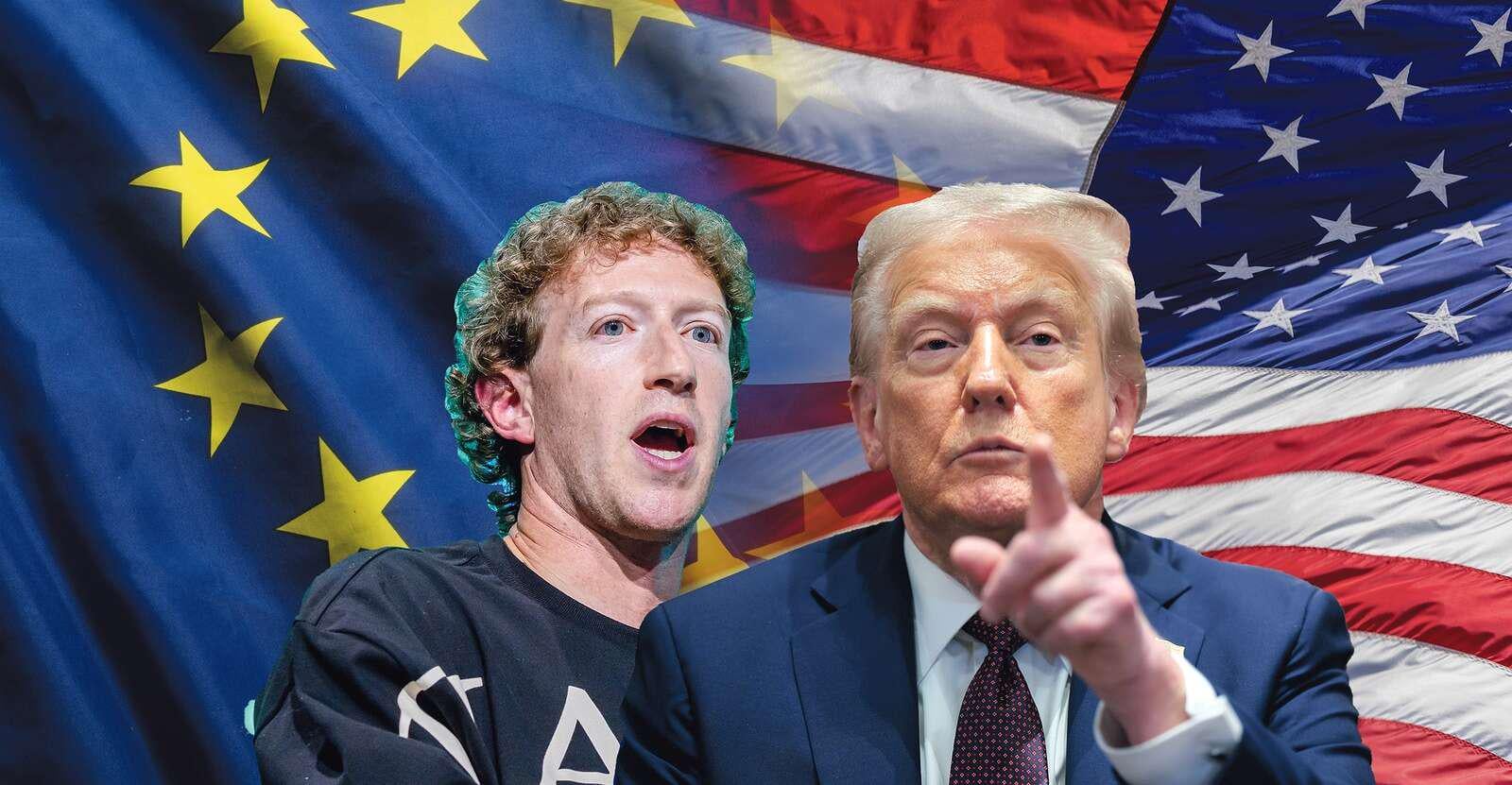
“Vogliono il cambio di regime in Europa”: come le aziende tecnologiche e il presidente degli Stati Uniti stanno accumulando pressioni sull’UE
https://www.businesspost.ie/politics/they-want-regime-change-in-europe-how-tech-firms-and-trump-are-piling-pressure-on-the-eu/
di Crossstoney
9 commenti
“If the EU had hoped that the signing of a trade deal with the US earlier this month would usher in a period of calm, it was swiftly disappointed.
Less than a week later, Donald Trump was issuing new tariff threats over the bloc’s tech rulebook, and pressuring foreign countries to end the use of digital taxes.
The fact that American firms hate EU tech rules and taxes is not new. Neither is the fact that they are lobbying in Washington, Dublin, Brussels and elsewhere to make their case.
But what is new is the way in which Donald Trump’s administration is backing them. Just days after the Meta boss Mark Zuckerberg visited Trump in the White House, where they discussed tech taxes, the president took to his Truth Social account to press foreign countries to change their laws.
Alexandra Geese, a German Green MEP and one of the European Parliament’s lead negotiators on the EU’s flagship digital services act (DSA), said that tech CEOs have more sway than ever over the US administration.
“We’re not talking classical lobbying,” she told the Business Post. “It’s a completely different order of magnitude. They want regime change in Europe, and the DSA is their obstacle.”
The DSA, which allows Brussels to step in over the heads of Irish and other national regulators to counter hate speech, disinformation or election interference, is seen by Zuckerberg, X owner Elon Musk and US vice-president JD Vance as censorship.
“Even before the US elections, JD Vance was saying that if the EU keeps up the DSA, the US was going to pull our troops out of Nato,” Geese said. “I remember at the time I thought ‘this is completely crazy, because it’s just so over the top’. And now I’m rethinking this. And I think, well, they actually might.”
At an event in Austria last week, the commission’s director general for trade Sabine Weyand, who led the recent tariff talks, said the bloc was effectively bounced into accepting a trade deal with Washington after the US threatened to “abandon the security partnership with the EU” if Brussels refused to play ball.
Weyand said the EU will have to accept the fact that the world is “more power-based than rules-based at the moment”.
Ursula Von der Leyen, the EU Commission president, insisted that there was “no linkage” between security and trade in her talks with the US, and that ending the tariff uncertainty was top of her mind during the negotiations.
“For me, it was important that we had predictability and stability for our businesses and our economies,” she told reporters in Helsinki on Friday.
“You see in those regions where no deal is achieved, but high tariffs are there, how advantageous it is to have the predictability, to have the stability and to have the clarity between us.”
While the Finnish prime minister Petteri Orpo said that “we have to be happy” with what Von der Leyen achieved, several former and current commissioners are urging her to stand up to Trump on tech, which was left out of the transatlantic trade deal despite pressure from the US to include it.
Ex-industry commissioner Thierry Breton, who resigned before his term ended last year, wrote in the Guardian of the need to “push back now” or face “humiliation and instability”.
Von der Leyen’s current industry chief, Stéphane Séjourné, said that the trade deal will “have to be reviewed” if Trump follows through on his threats to sanction countries that implement the Brussels rulebook, including through suspending visas of foreign regulators.
“That’s a credible threat,” MEP Geese said. “I mean [secretary of state Marco] Rubio made it in April, and now they’re doubling down. I would be on that list, probably.”
Competition commissioner Teresa Ribera said the bloc should “avoid the temptation of being subordinated to others’ interests”.
The tech industry is unsure of how to handle the stand-off. One industry source said the US threats make things more complicated for companies that are trying to push for the EU to pare back what they insist are complex and overlapping tech rules.
“Trump has narrowed the space for what the commission can do,” the person said on condition of anonymity. “If the commission settles any points … it might actually look weak and everyone will interpret it as it bowing to Trump. But we will continue to fight the good fight.”
Regina Doherty, Fine Gael’s MEP for Dublin, said the EU should not “concede even an inch” to Trump or risk not being taken seriously.
“Eventually small concessions turn into big concessions, and then where is our authority? It becomes totally undermined and the next time [Trump] wants to throw toys out of the pram, what do we do?” she told the Business Post.
“If you want to do business with the EU, then you adhere to the laws. If you don’t like the rules and the engagements that we have in our territory, well then take your business somewhere else.”
Another industry source, who did not want to be named because of what they said was the political sensitivity around the trade deal, said a better way for US tech firms to reduce EU tech rules is to wait for a review of the DSA scheduled for this November.
“There are opportunities to go about these things, but trying to do it right after a trade deal and by making further threats is not it,” the person said. “The EU can’t bow down to that. We’ve told that to the Americans. It’s a bit of an own goal in trying to achieve the things they would like.”
Also on the way in November is a new omnibus law targeting EU tech rules, part of the commission’s so-called simplification agenda. But tech companies are not confident it will mean real deregulation.
In his Guardian piece, Breton spoke of an “ever-widening gulf of misunderstanding” between the EU and US on digital regulation, “a gulf that the major tech platforms – American, in this case – are exploiting to the hilt”. For now at least, there is no sign of that gulf narrowing.” – Business Post
Ask yourself “When is it enough?”
But you know, EU is like 27 democratic countries (or 26 with exception of Hungary).
Perhaps, take care about American problem first, before you imagine that you have something to say to others.
Hostility and bullying towards all but Putin and a few other monsters is what the Trump presidency is all about.
There are no words for how vile this is.
This is why union should start to make money not just with US. I know it’s the easiest. But in fact invest wise in Europe. Make European own War sector. Additionally tax the hell facebook, Amazon and other big US company’s.
To make Donald happy help democrats.
People don’t seem to realize that the plan is to bring what they did in the US to the EU too, and their chance of success is absolutely 100% if the saboteurs working for years against the EU stability from within aren’t stopped right now, although I think it’s already too late. It will require more time because of different countries, different election times, political leaning etc. but one by one all EU countries will fall under the far right cancer if all the remaining sane leaders can do is gather around a table and talk forever. Once it happens we can say goodbye to democracy forever; this time there will be no allies to come and save us.
So this anonymous guy just told the US administration how to make the EU bow down but with better optics? Traitor.
The EU is bringing it upon itself. The rise of far right predates the tech era and is clearly endogenous.