
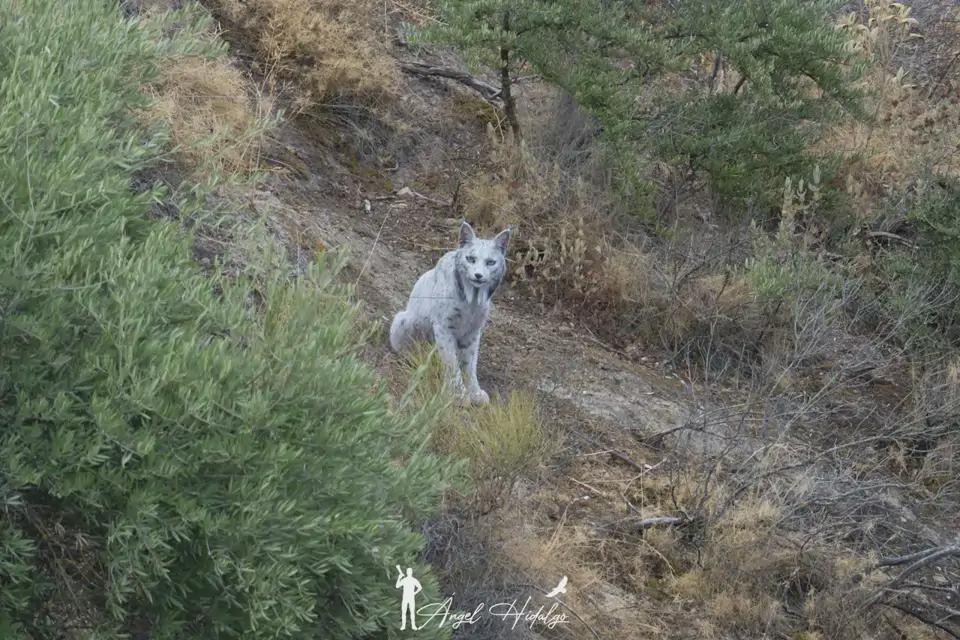
Buone notizie, tanto per cambiare. Per la prima volta in assoluto, le telecamere hanno catturato una lince iberica leucistica dal mantello bianco a Jaen, in Spagna. Si tratta di un traguardo importante dopo che la specie è stata recentemente rimossa dall’elenco delle specie a rischio di estinzione. Il duro lavoro paga!
https://i.redd.it/22urq0mvh3yf1.jpeg
di Jaszs
5 commenti
Also a lot of, uh, ‘hard work’ on the part of the lynxes.
Beautiful
# Historic sighting of a ‘white’ Iberian lynx in Jaén: the photographer recounts how the discovery was made
The success of efforts to preserve this species has given us an unexpected sight: the first leucistic specimen.
The reclassification of the Iberian lynx (Lynx pardinus) as a vulnerable species rather than endangered in 2024 was one of the latest major milestones for biodiversity in Spain. In just one year, the population on the Iberian Peninsula increased by 18.8% to more than 2,400 individuals, including 470 females, according to MITECO. Twenty-one entities and different autonomous communities are participating in the program, which aims to reach 3,500 individuals and 750 breeding females to leave the vulnerable status behind.
As an unexpected result of this growing population, an amateur photographer has captured a leucistic Iberian lynx with his camera in Jaén, a characteristic never before documented in this species.
Why is the photo of the ‘white’ Iberian lynx historic? What does it mean? The white coloration is a genetic modification caused by reduced pigmentation. This variation causes the cells to develop differently and be unable to produce pigments. Leucism is usually observed as ‘discoloration spots’, unlike albinism, which affects completely white animals. These striking deviations are new ways for nature to surprise us.
The Iberian lynx observed was in Jaén and is part of one of the five populations in Andalusia. We will likely learn more details in the census that is always conducted at the end of the year. In the last record, there were 22 populations between Spain and Portugal.
The specific location was not disclosed in order to protect the animal. Poaching continues to be one of the main threats to the preservation of the species. But that’s not all: the decline in the wild rabbit population—its main food source—over the last ten years has also put the survival of the Iberian lynx at risk.
Ángel Hidalgo is 29 years old and when he is not at the construction materials factory where he works in Jaén, he spends almost all his free time observing nature. His greatest passion is capturing animals in their natural habitat, as he shares on his Instagram account.
Traveling throughout Andalusia in search of unpublished images, he saw an Iberian lynx for the first time five years ago. Over time, he organized his hobby: “At different times of the year, it is easier to photograph certain species: in October, I follow the deer rut; November is good for mountain goats; in December, the lynx rut. Depending on the date, I devote more time to one species. That is my greatest passion,” he tells National Geographic exclusively.
But he never imagined that one of his photographs would end up being so valuable. First, he set up a camera trap more than a month ago. When he began reviewing the images, he couldn’t quite believe what he was seeing: “I couldn’t believe it. I thought it was a camera effect, and from then on I dedicated myself to searching for the lynx. I’m still in shock.”
And the search has yielded good results: just a few days ago, he saw with his own eyes—and captured with his camera—**the first leucistic Iberian lynx in history.**
This photographer’s efforts to capture an extraordinary image have a backdrop: **the exciting success story of the preservation of the species on the Iberian Peninsula.**
*News article in spanish*[ *here*](https://www.nationalgeographic.com.es/mundo-animal/historico-avistamiento-jaen-lince-iberico-blanco-fotografo-aficionado-cuenta-como-fue-espectacular-hallazgo_26567) *(translated with Deepl) — there’s a link to an instagram video there!*
Is it wrong that I expect him to sound like Puss in Boots?
Some good news for a change. Beautiful cat.